
Carney Wins the Canadian Federal Election: Will He Hit the Mark?
On April 28th, Canadians went to the federal election polls for the 45th time as a nation, electing Liberal Party leader Mark Carney as Prime Minister and providing the federal Liberal Party with its fourth consecutive mandate.
The election ended up being a two-horse race between the centre-left Liberal Party led by Mark Carney and centre-right Conservative Party led by Pierre Poilievre. Both parties campaigned on a message of change – the Liberals campaigning on a change of face, Carney in place of Trudeau, and both parties campaigning on a shift toward stimulating economic growth and better supporting Canadian households in the face of global trade uncertainty.
US tariffs on Canadian imports and US threats to Canadian sovereignty became the focus of both election campaigns. Prior to former PM Trudeau’s resignation in January, Canadians were overwhelmingly signaling their intention to vote in anger against Trudeau’s Liberal Party, which had governed Canada for almost ten years, years in which Canadian productivity growth lagged peers and Canadian households saw their purchasing power and discretionary income stagnate on average.
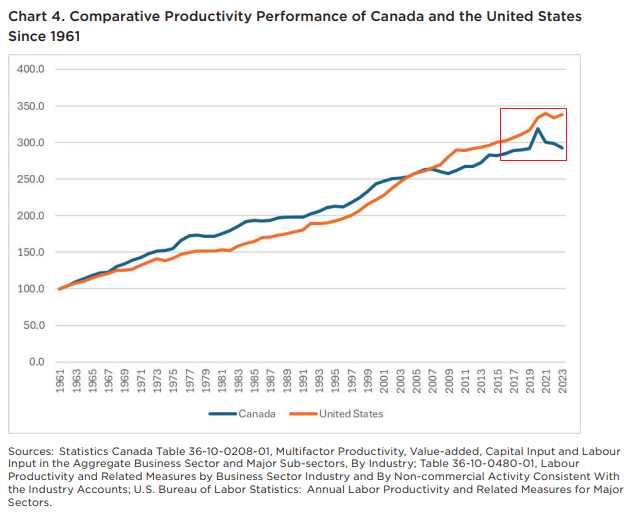
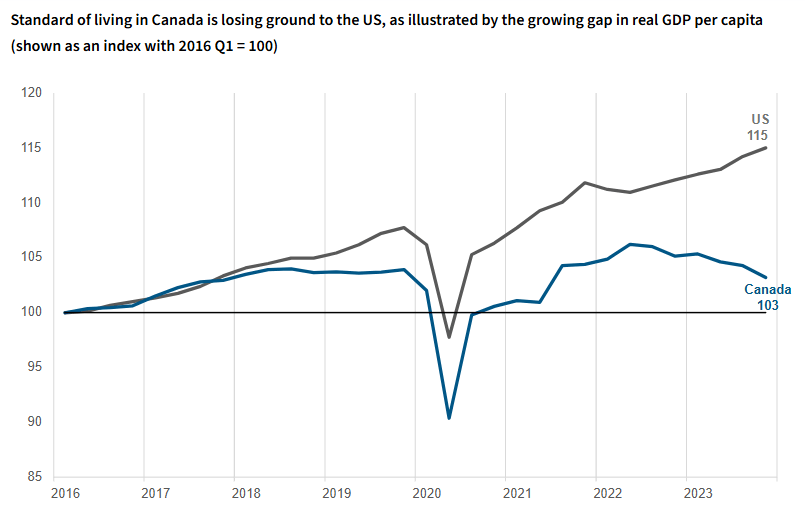
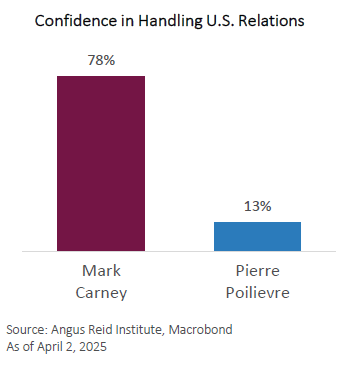
Following the inauguration of Donald Trump in mid-January, and subsequently the replacement of Trudeau with the seemingly more business-friendly Carney, accusations about which political party contributed to Canada’s current precarious economic situation faded and the election became more about the public’s perception of each candidate’s likeability, disposition and capability to ward off American trade aggression. Canadians broadly preferred the Liberals’ Carney over the Conservatives’ Poilievre, partly due to Carney’s calming and collaborative disposition as well as his longer and arguably more distinguished track record of employment including senior roles at Goldman Sachs and acting as the governor of both the Bank of Canada and Bank of England.
The Liberal Party headed by Carney went from a near zero percent chance of winning the election in early 2025 to a near 100% chance of winning by early April.
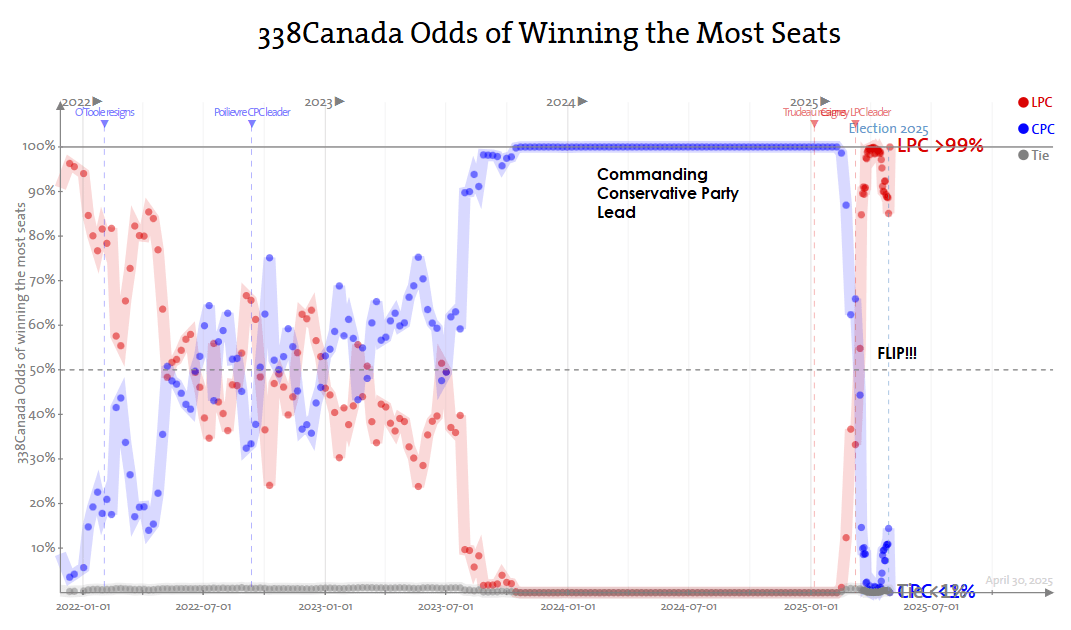
While the Liberals ended up winning in a definitive manner, twenty-six seats ahead of the second place Conservative Party, they secured only 170 seats, short of the 172 seats required to form a majority government. This sets the party up to form a minority government with support of either the New Democrat Party (NDP) or Bloc Quebecois (BQ), if they are willing.
The previous Liberal government was dissolved largely due to a lack of support from the NDP and BQ. It will be interesting to see if the Liberals under Mark Carney can drum up enough lasting support to form a government and enact policy to combat the primary issues facing Canada such as alleviating US trade tensions, tackling slow economic growth at home, and balancing energy sector demands with climate goals. With a stronger mandate, a new NDP leader on the horizon, and pressing economic issues that encourage a united Canadian posture, it appears more likely now than in the recent past.
What is the Liberal Party Platform and Its Expected Effect on the Economy?
The official Liberal Party election platform includes increased government spending with a focus on protecting the Canadian economy against tariff threats by:
- Reducing internal trade barriers and labour mobility restrictions, expanding the Canadian economy by as much as $200 billion,
- Promoting a ‘Buy Canadian’ agenda, prioritizing Canadian companies as part of federal procurement,
- Cutting income tax rates for middle-income Canadians to support domestic consumption,
- Investing in nation-building infrastructure projects including roads, tunnels, rail, ports and an east-west electricity grid,
- Providing a $2 billion strategic response fund to protect the auto sector and manufacturing jobs affected by US tariffs as well as provide funds to allow impacted workers to ‘upskill’,
- Supporting housing development by expanding funding and loans to affordable and prefabricated home developers, cutting GST for first-time homebuyers on home sales below $1 million, and opening up public land for development,
- Committing to support clean energy supply and developing critical minerals, and
- Committing another $31 billion in defense spending over four years, increasing defense spending to 2% of GDP from 1.4% now.
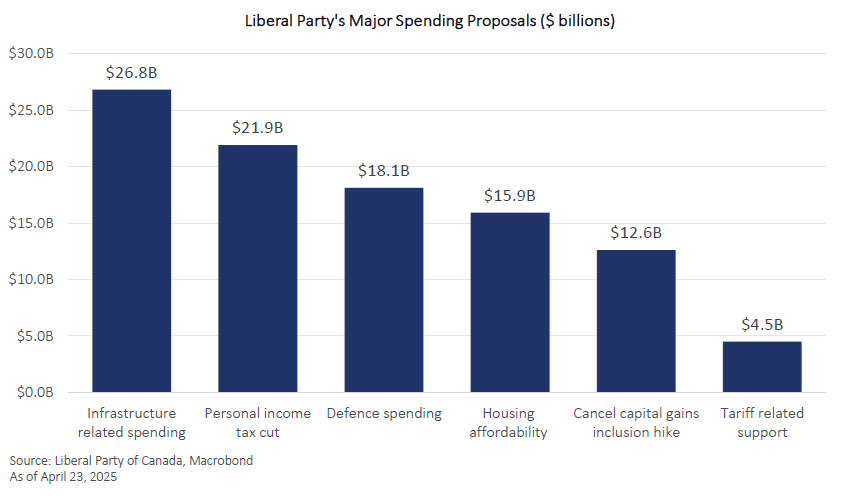
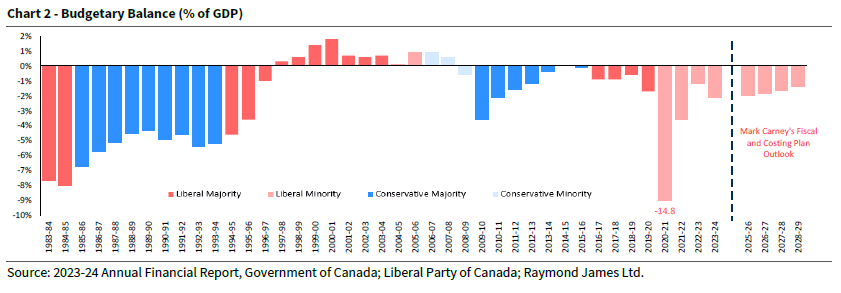
Assuming all policies are enacted as proposed, budget deficits are expected to stay at over 1.5% of GDP over the next few years, not far off from where the previous Liberal government left off.
The government’s immediate and arguably most urgent priority remains US trade relations, and it is fair to expect Carney to tackle this problem first. In the second week following the election, Carney visited Trump at the White House to highlight Canada’s commitment to the trade, security and defense partnership it has with the US. Most would agree that the meeting went well but with little progress in terms of trade. Reducing tariffs on Canadian imports may take some time and there may not see any major improvements with respect to tariffs until the Canada-US-Mexica Agreement (CUSMA) is renegotiated, a negotiation which is scheduled for 2026.
The policies that the Liberal government will be able to enact in the coming years will depend on whether it can garner support from other parties, particularly the NDP and BQ. These parties may require concessions in line with their own party’s priorities in exchange for support of policies that the Liberals are hoping to enact. Political deals of this type can further complicate the government’s ability to roll out its platform and remain on track with budgetary goals. The previous Liberal government made major policy concessions with the NDP in exchange for its voting support and this ended up adding additional stress to the federal budget and a worse-than-expected budget outlook was what ultimately sunk that Liberal government. Carney will need to walk a tightrope to get things done while staying on track fiscally.
If the Liberal government can pursue its platform as it pleases, this is sure to benefit the renewable energy and engineering and construction sectors as increased public investment will help lower the cost of companies operating in these sectors. On the flip side, a Liberal government may be less than ideal for the oil and gas sector. Carney has stated that he wishes to make Canada an ‘energy superpower’ but has not yet made any major commitments to new pipelines or a reduced carbon tax for the sector, two factors that are make or break when it comes to energy sector investment. As for other sectors, especially those cyclical and export-oriented sectors like industrials, mining/materials, and consumer discretionary, the impact will largely depend on the progression of trade talks.
We are in the early days of the current minority federal government so much is still up in the air. We will learn over the coming months what political deals end up being made and what policies end up being prioritized as a result.
News and our views
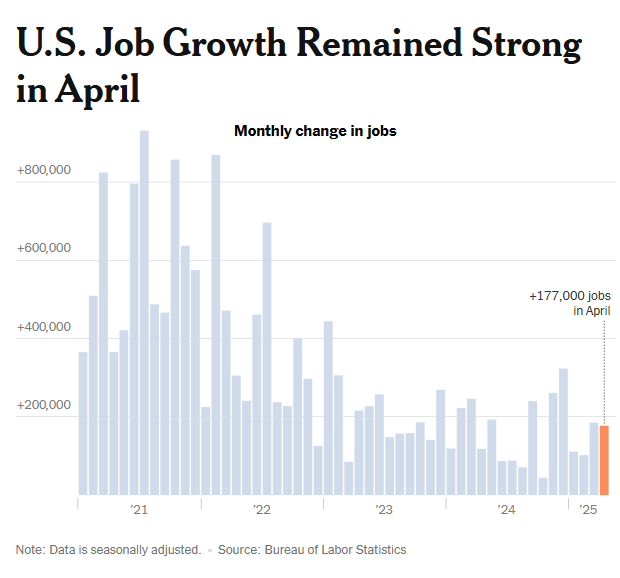
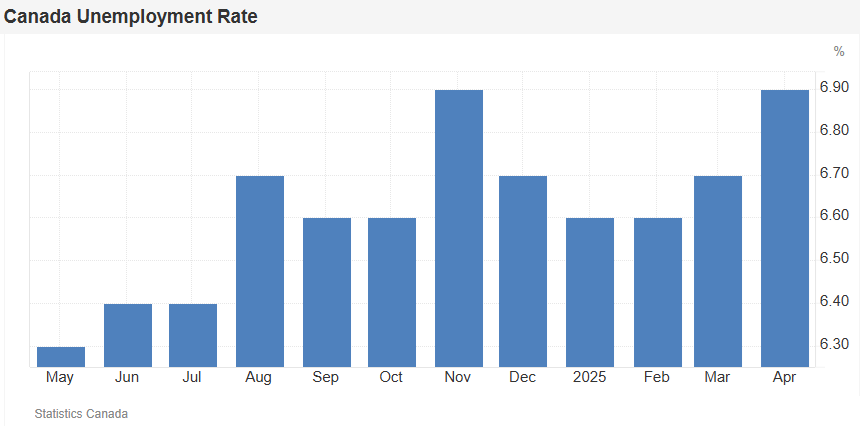
US Tariffs Quickly Bite Those Economies Most Affected. In March and April, Canadian and Mexican employment fell leading up to and following the implementation of 10% tariffs on energy and potash and 25% tariffs on all other goods not covered by the Canada-US-Mexico Agreement (CUSMA). As one might expect, the largest job losses experienced in these countries have been in sectors related to manufacturing and trade. Canada and Mexico have been slapped with greater US tariffs than all other nations except China. While data is murky out of China, plans to support jobs and help exporters highlights growing stress in these areas of the Chinese economy. Even other nations that have been hit with lesser US tariffs, Europe and Japan for example, have experienced labour market weakness due to heightened trade uncertainty. The US economy on the other hand continued to add jobs over this period, despite trade uncertainty.
Our Take: It is difficult to tell how deep US tariffs, and any retaliatory tariffs, will cut into the affected economies. Stimulus spending, as proposed by Canada’s Mark Carney and other leaders around the world, will help alleviate some of the short-term pain related to changes in production and consumer spending. In the week of May 5th, the US and UK announced a proposed trade deal which helps lower some tariffs and increase trade opportunities for both nations. If we see more deals like this, the effect of US tariffs could be neutral or even positive to global economic growth in the long run. That said, some nations appear less willing to negotiate than others so it may take a long time before trade uncertainty is reduced.
Just for fun
- In April, Laura Prust celebrated 25 years as an integral member of the Steele Wealth Management team. Two and a half decades of fostering close client relationships – time flies when you’re having fun! Laura celebrated her 25 years with Steele Wealth Management by taking a pilgrimage to Ireland with family. Here is a picture of Laura at the Cliffs of Moher.

- Time catches up to the Oracle of Omaha. At age 94, and after six decades at the helm of Berkshire Hathaway, Warren Buffett has announced his retirement as CEO and his intention to hand the reigns over to vice-chair Greg Abel (a born and raised Albertan by the way) at the end of the year. Buffett will stay on as Chairman of the Board. Despite the announcement being inevitable given Buffett’s ripe old age, Berkshire stock fell ~5% the following day. Being an Oracle is hard enough, but can you teach one to be an Oracle? This is the question that Berkshire Hathaway investors are now asking themselves.
- Rest in peace Pope Francis. Following His Holiness Pope Francis’s death on April 21, 2025, rumours swirled about who the College of Cardinals would select as the next Pope. Cardinal Secretary of State of Vatican City Pietro Parolin (effectively the deputy Pope) and Luis Antonio Tagle, the progressive head of the Church’s missionary arm, were slated as the two favourites. In the end, Cardinal Robert Francis Prevost was elected the 267th leader of the Roman Catholic Church on May 9, 2025. The Peruvian-American, who chose the name Pope Leo XIV, is the first-ever US born Pope to lead the Church and the first Pope from the Augustinian order, a subset of the Catholic church founded on unity/community, love and the pursuit of truth through learning.
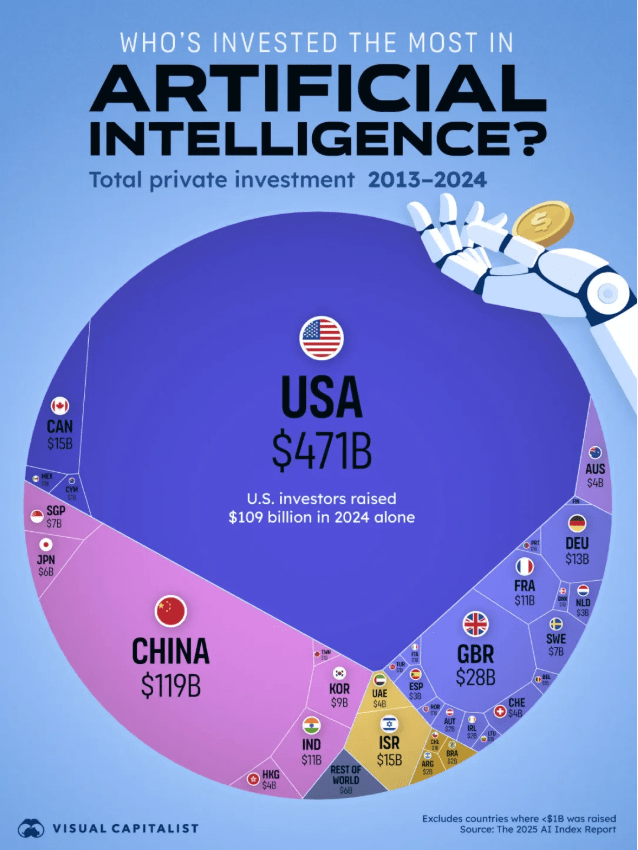
- Who will win the AI arms race? AI investment has been driven by two countries but one country has a lot more skin in the game…