CA Client Login
 US Client Login


THIRD QUARTER 2026 : THE BOND MARKET RULES THE WORLD!
Global Bond Yields Quietly Hit Multi-Decade Highs, Pressuring Companies With Above Average Debt Obligations, As Well As Debt-Heavy Economies and Households
There is a financial adage that is often overlooked or forgotten – the bond market rules the world.
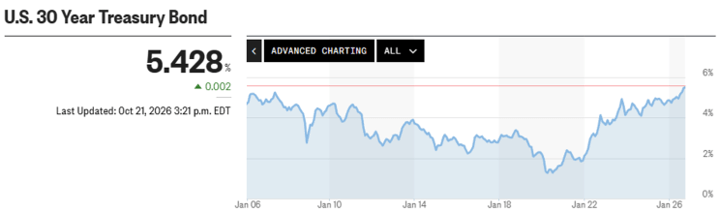
Fixed-income securities and most notably US Treasury bond yields establish the fundamental cost of capital across the globe and act as the ultimate anchor for the entire global financial system. Government bond yields are considered the “risk-free rate” for each government’s economy, from which all assets – stocks, corporate bonds, real estate – are valued. Higher government bond yields often persuade central banks to raise their short-term benchmark interest rates (many central banks have raised interest rates in recent months) to help stymy economic growth and inflation pressures that are pushing interest rates higher.
Higher short-term benchmark interest rates and long-term government bond yields reliably result in:
- Higher corporate bond yields, immediately with respect to variable debt (mortgages, lines of credit, floating rate debt) or when fixed rate debt matures or resets,
- Higher rental yields on real estate, as landlords pass on higher mortgage interest costs to tenants and new builders require higher rents to cover their higher costs unless real estate prices fall enough to make up the difference, and
- Higher stock dividend yields (which typically involves stock prices falling), although the correlation between rising interest rates and falling stock prices is inconsistent and strong correlations typically only occur in the short-term (see: 2022 inflation spike and equity market decline, followed by a quick recovery).
Most of the time, bond markets and bond yields are relatively stable and their effect on economies and equity or real estate markets is minimal, but after three years of relative stability, government bond yields in nearly all developed economies have broken out to new highs and many central banks around the world have begun to raise short-term benchmark interest rates to combat rising long-term bond yields.
Why Are Long-Term Bond Yields Hitting New Highs?
Inflation remains a concern in nearly all economies around the world. The ongoing wars in Iran and Ukraine continue to limit access to critical energy production and critical minerals that are essential for the smooth operation of the global economy, and as a result, commodity prices remain elevated relative to the period before the start of the Iran war. At this point, it appears that these conflicts are not likely to end soon, and the inflationary pressures are unlikely to subside, supporting higher-for-longer bond yields and interest rates.
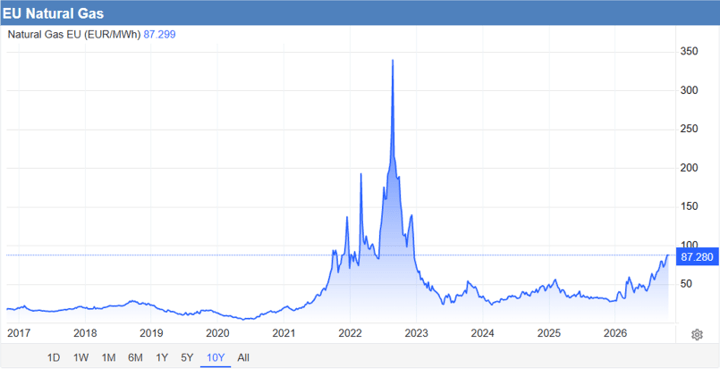
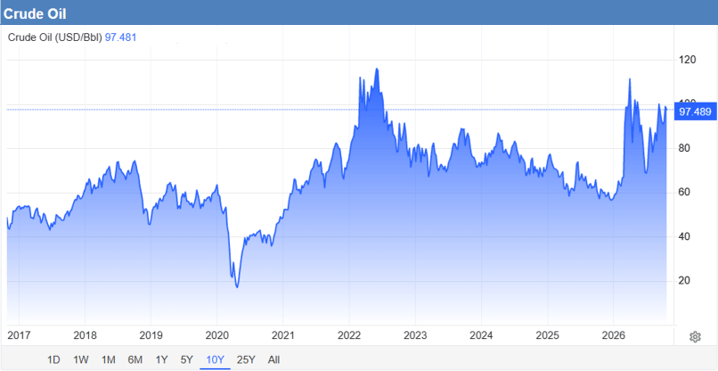
Inflation concerns do not equally affect all economies and the companies and households operating within them. The energy shortage can be seen as a neutral or even positive for energy exporting economies like Canada, the US, Australia, and Brazil and distinctively negative for energy importing countries like the UK, Germany, and Japan. Government bond yields in energy importing countries have jumped to levels well beyond the highs seen following the start of the 2022 Ukraine war and ensuing energy crisis. The current Iran-war-induced energy shortage appears to be more extreme than what we experienced in 2022-2023 with European natural gas-in-storage currently sitting at a 15-year low for this time of year and European natural gas prices at their highest level since 2022, causing inflation expectations (and in turn government bond yields) for Europe and other energy importing countries to rise significantly. Global crude oil prices are also elevated, adding to inflation pressures for these economies.
On the other hand, despite a neutral to positive impact in energy exporting countries, government bond yields in those countries have also poked above the 2022 highs but remain somewhat contained, for now.
There are two key differences between the current bond market and the bond market following the start of the 2022 Ukraine war.
1) Government budget deficits around the world continue to rise. After the pandemic-related government spending binge, it was expected that governments would become diligent in reducing deficits during an expansionary economic environment. Instead, we’ve seen two of the largest wars since WWII break out, pushing governments to commit to significantly higher defense spending (e.g. 5% of annual GDP to be spent on defense by NATO members). Additionally, significantly higher debt-servicing costs due to rising bond yields have created a snowball effect that will be difficult to counter without cuts to entitlement and/or healthcare spending, but market forces have yet to incentivize governments to make such cuts, which is most often the only way cuts to these programs are made. Larger budget deficits mean larger debt issuances are required to balance the government’s books.
2) Unprecedented spending on AI datacentres. In the race to become the infrastructure that AI large language models operate on for years to come, ‘hyperscalers’ are expected to spend nearly US$1 trillion on building datacentres in 2026 and are expected to spend another US$6 to US$7 trillion on building AI datacentres between 2027 and 2030, as per Gartner, McKinsey and Goldman Sachs estimates. JPMorgan estimates that ~US$4.1 trillion in debt will need to be raised to fund through 2030. If the AI datacentre buildout continues as expected, AI-related bond issuance is just getting started.
The combination of these two factors has resulted in a record amount of bond issuance in recent months, and this bond issuance is not expected to abate anytime soon. All these new bonds need to find new buyers, which means issuers need to compel investors currently holding cash, equities or other investments to sell those investments and buy bonds. These new buyers didn’t buy the bonds at the previous price/yield, so you need to convince them otherwise.
“…the competition for capital is as large as I've ever seen in my professional career.”
Blackrock CEO Larry Fink, head of the world’s largest asset manager
Everyone loves a clearance sale! The best way to think of it is that these issuers need to have a clearance sale, offering these new bonds at lower prices, which come with higher yields, incentivizing investors currently holding cash, equities or other investments to switch to these new bonds. The problem is that these new government and AI-related bond issuances are so significant that it impacts the entire global bond market, pushing yields on all bonds higher. In the process, this increases the cost of capital and nearly everyone in society pays for government deficits and the AI datacentre buildout, one way or another.
On a side note. The cool thing is that there is a limit to how many additional bonds that governments and AI companies can issue, and when bonds become too difficult to issue, bond issuance will hit a wall and the rest of society will start to pay less and less to support these initiatives. This is how booms and busts work throughout history and how they interact with general society. Yes, economics can be cool, and relevant, sometimes!
How Are Other Markets Taking It?
Equity markets, as measured by global equity indices like the S&P 500 Index (US), S&P/TSX Composite Index (Canada), and MSCI ACWI Ex-US Index (World ex-US) remain near all-time highs but these indices are highly concentrated and don’t represent the experience of the average company/stock.
For example, as of September 30th, the S&P 500 trades within 2% of its all-time high, suggesting that equity markets are doing well and the outlook for future economic growth and corporate profits remains positive. Beneath the surface, the average stock is under pressure. Approximately 60% of S&P 500 stocks are in a bear market, meaning they are down over 20% from their all-time highs. Only twice before, in the 1973-1974 Nifty Fifty and 1999-2000 dotcom bear markets, has the S&P 500 been this close to all-time highs while most S&P 500 stocks are in a bear market. The discrepancy between the performance of the S&P 500, which has a high concentration in megacap technology, AI companies and other participants in the AI datacentre buildout, and the average stock, is a direct example of AI investment increasing the cost of capital and crowding out other parts of the economy, to the detriment of the average stock.
Stocks in the utilities, real estate, financials, telecom and consumer discretionary and staples sectors are bearing the brunt of the higher cost of capital as many consumers have less discretionary income available and higher interest costs start to bite. That said, even some of the beneficiaries of the AI datacentre buildout – stocks like CoreWeave and Oracle in particular – are starting to struggle as investors grow increasingly worried about whether the significant amounts of debt raised today can be serviced by future revenues tomorrow.
Real estate markets are slower to respond to changes in interest rates, but the majority of real estate markets continue to exhibit below average sales activity and flat or declining sales prices. Rising interest rates are likely to further entrench this trend, a trend that has been in place since the pandemic highs of 2021-2022.
How To Position Portfolios Going Forward?
With many stocks down over 20% from their all-time highs due to a temporary, AI investment induced increase in the cost of capital, there are many new opportunities to buy into strong businesses with long track records of profitable growth at valuations that are below historical norms. History shows that the stocks that significantly lag broad equity indices during the boom phase tend to generate above average returns when the boom phase turns to bust. There are numerous indicators showing that the bust phase may have already begun:
- Semiconductor and memory chip stocks formed a ‘double-top’ trading pattern in recent months,
- Smaller, more pure-play AI infrastructure companies that depend on debt financing, like CoreWeave and to a degree Oracle, are trading well below (50%+) their all-time highs and the yields on newly issued bonds are approaching or are in line with distressed debt, which will make issuing new bonds to fulfill AI spending commitments quite difficult,
- Private market valuations of leading AI large language models have begun to decline for the first time due to slowing and underwhelming revenue growth and greater-than-expected losses (valuation trends tend to persist in private markets).
For these reasons, our conviction that those blue-chip stocks outside of the AI boom that currently trade at depressed valuations could soon begin to see increasing investor attention and rising valuations, as hype around AI-related companies begins to fade.
Let us be clear, we are not saying the AI datacentre buildout will stop nor that AI large language models development will halt, we are simply saying that investors have likely overestimated how profitable AI investments will be in the coming years relative to the amount spent on and committed to AI infrastructure and model development.
If the AI trade begins to fade and non-AI-related stocks begin to see more investor attention, this would resemble a continuation of the rotation out of tech stocks and into the rest of the market which started in early 2025 but took a break in Q2 and Q3 of 2026. Rotations out of long-winded rallies in technology stocks tend to last many years, so it is not a reach to expect that we see a continued follow-through in the rotation out of tech stocks and into stocks outside of the tech sector. That said, the recent AI trade has resulted in price weakness for many software stocks, and we could see a recovery in these stocks as well this time around.
A continued rotation would be generally positive for Canada, international markets (though watch for energy price sensitivity), small- and mid-cap stocks, both in the US and abroad, and lower valuation stocks relative to higher valuation stocks. Specific stocks that have recently popped onto our radar and stand out in terms of trading at historically low valuations, having strong and enduring market positions, and having long-term track records of growing earnings are engineering companies Stantec (STN) and WSP Global (WSP), property & casualty insurance company Intact Financial (IFC), consumer staples companies Constellation Brands (STZ) and Lamb Weston (LW), and software companies Constellation Software (CSU), Descartes Systems (DSG), and Zillow (Z), to name a handful.
We believe it makes sense to continue holding core big tech companies that have market-leading positions and generate consistent revenue growth like Alphabet (GOOG) and Amazon (AMZN), although paring down these positions when material gains arise is important to manage portfolio risk.
As interest rates and bond yields continue to march higher, expected returns from fixed income are rising and owning fixed income is looking increasingly attractive. Due to the strong trend of rising bond yields (and falling bond prices) and greater and growing bond issuance, we continue to favour shorter term and higher quality fixed income securities to help limit the potential for near-term losses while satisfying portfolio income needs.
Mortgage investment corps (MICs) and public credit funds have continued to pay consistent income with limited volatility while many funds holding long-lived assets in the private equity and private credit segments struggle under a period of relatively high interest rates. Fund manager selection is key, and we are starting to see the value of picking experienced fund managers.
Maintaining a well-diversified portfolio tailored to your risk tolerance is the best way to avoid major negative surprises and participate, if not capture the majority of upside provided by asset markets over time. You can be sure that we are tracking all market developments and are making portfolio adjustments to manage risk and pursue returns as investment opportunities arise.
If you ever have any questions or concerns about your portfolio or the investment markets in general, please feel free to reach out to us.
Sincerely,
The information contained in this report was obtained from sources believed to be reliable, however, we cannot present that it is accurate or complete. Information has been sourced from the RJL Bond Desk or RJ Private Client Solutions, unless otherwise noted. Index and sector returns represented in this commentary are measured using the S&P/TSX Total Return Index and S&P/TSX GICS Sector Indices as detailed in Raymond James Ltd.’s Insights & Strategies: Quarterly Edition. This report is provided as a general source of information and should not be considered personal investment advice or solicitation to buy or sell securities. The views expressed are those of the author and not necessarily those of Raymond James Ltd. (Member Canadian Investor Protection Fund).
This Quarterly Market Comment has been prepared by Steele Wealth Management and expresses the opinions of the author and not necessarily those of Raymond James Ltd. (RJL). Statistics and factual data and other information are from sources RJL believes to be reliable but their accuracy cannot be guaranteed. The performance outlined in the report is net of fees. The client account performance may vary from the model portfolio due to several factors, including the timing of contributions and dates invested in model. The performance reported is that of the account that represents the model, not a composite. Performance calculation for the models may be different than the index used as a reference point. It is for information purposes only and is not to be construed as an offer or solicitation for the sale or purchase of securities. This Quarterly Market Comment is intended for distribution only in those jurisdictions where RJL and the author are registered. Securities-related products and services are offered through Raymond James Ltd.
Commissions, trailing commissions, management fees and expenses all may be associated with mutual fund investments. Please read the prospectus before investing. Mutual funds are not guaranteed, their values change frequently and past performance may not be repeated.
Raymond James (USA) Ltd. advisors may only conduct business with residents of the states and/or jurisdictions in which they are properly registered. Raymond James (USA) Ltd. is a member of FINRA/SIPC.