CA Client Login
 US Client Login

The Family Office Mindset - Think Like A Billionaire
family office n. a private company (or dedicated team) created by a wealthy family to manage their money, assets, and daily affairs.
Although family offices are often associated with ultra-high-net-worth families, the principles they employ can benefit any successful business owner or professional. The family office mindset is about seeing wealth holistically and making intentional decisions with your wealth using the same discipline that allowed you to build wealth in the first place.
A good starting point to launch a family office mindset is to establish a family charter defining your shared values and long-term vision. This charter would define:
- Guiding principles and long-term ambitions that unite the family
- What is this wealth intended to accomplish?
- What values should guide financial decisions?
- How should future generations be educated about money?
- Clarifies how decisions are made and each family member’s responsibilities
- Establishes formal processes for conflict resolution to help limit emotional friction
- Provides guidelines for asset distribution (from trusts or otherwise), inheritance, and philanthropy
- Clearly outlines leadership transitions across generations, something that isn’t necessarily delineated in wills or powers of attorney
- For business owners, it establishes rules around employment and career advancement
Not all families that operate with a family office mindset have a written charter, but sitting down and writing one as a group can help formally bring all family members up to speed about what the family’s goals are and when the family expects to achieve them. Like wills and powers of attorney, family charters should act as a living document that evolves as the family grows and situations change.
Once a charter is in place, the family can start building their team to assist with the four core functions:
- Wealth Management – investment management, life insurance strategies, trust solutions, and estate, tax, and income planning
- Tax planning – filing personal, corporate and trust income tax returns, and real estate, corporate, and trust structures, trust administration
- Charity & Philanthropy – giving strategy, charitable giving funds (CGFs) and family foundations
- Family Governance – family councils, family meetings with and without outside professionals, business succession planning
Wealth managers, accountants, and lawyers are the core members of any good family office and are professionals that many families already use. Creating an informal family office isn’t that difficult. The key is to choose wealth managers, accountants and lawyers that are proactive and openly communicate with each other to achieve your family’s goals, and hopefully while reducing the amount of time you and your family are required to spend achieving said goals.
Once you have a team in place, you can design and implement your wealth management plan with the support you need to get the job done right and your plan properly monitored over time.
A key task which provides insight into which family goals are achievable or not is to segment the family’s wealth into capital tiers. This is something we help our clients determine early on by creating all-encompassing financial projections and tracking those projections over time to continuously confirm the family is still on track to meet their goals. This allows our clients to create context around the money they need for retirement and the money they can use to achieve other goals. If we know that only half of the financial assets are needed to fund a comfortable retirement, we know that half of the financial assets are available to support future generations and help create a legacy. From there, we can start to define what you as a family see as legacy and develop a plan to achieve that legacy. For more on building a legacy, see our article ‘Family Foundation? Not Just For the Rockefeller Types!’.
Once a legacy plan is in place, making an effort to ensure that it will endure is important. To ensure the family office mindset remains intact throughout time, instilling family values and educating future generations is paramount. Holding family meetings with multiple generations present and involving heirs in practical tasks and philanthropic discussions early can help instill family values that last a lifetime. Having your heirs sit in meetings with wealth managers, accountants and lawyers keeps them up to speed on the family’s affairs and objectives and allows them to ask questions about how things work before they become the decision-maker. If you want to get extra serious about education, there are cost-effective programs, such as those offered by Tamarind Learning, designed for families and individual beneficiaries that provide foundational education in estate planning, trusts, tax, investing, trust administration, financial planning, fiduciary oversight, trustee and beneficiary relationships, and working with your advisors. The more you learn before you need to know, the less you need to learn when you need to know.
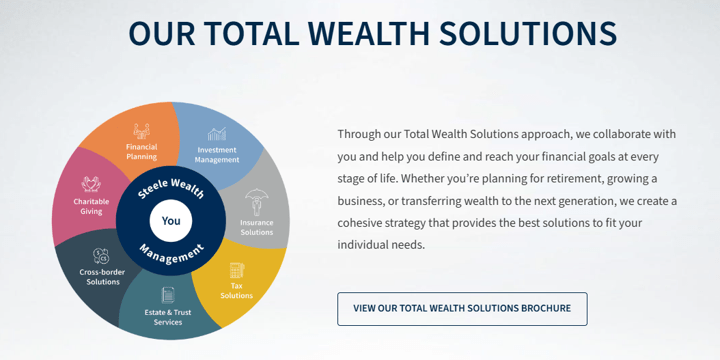
We at Steele Wealth Management employ a vision-based ‘Total Wealth Solutions’ approach to act as a quarterback for you and your family. In collaboration with you, we help you define and reach your financial goals at every stage of life. Combined with your legal and tax advisors, we can help you maintain a family office mindset now and for generations to come. Unfortunately, we don’t offer dry cleaning pickup services, so you’ll still have to do that yourself!
NEWS AND OUR VIEWS
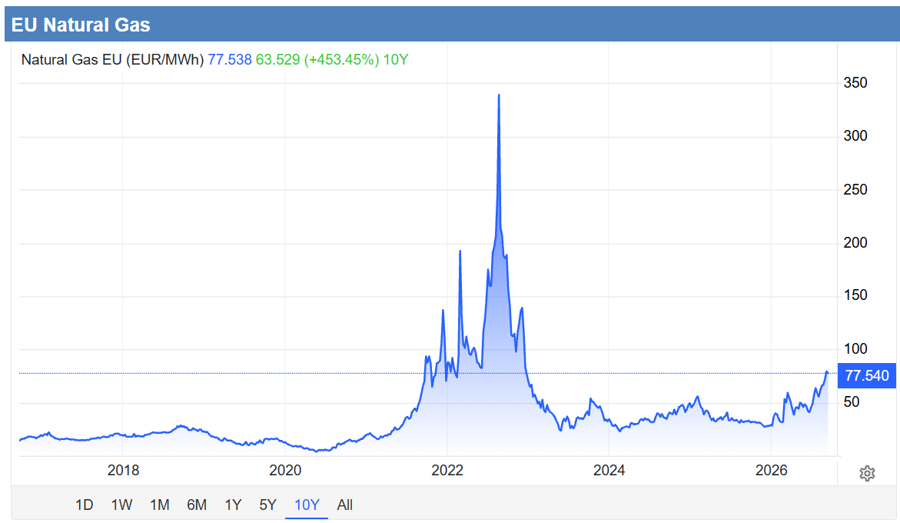
Global Bond Yields Hit a Multi-Decade High. Interest rates, represented in real time by global bond yields, hit multi-decade highs in late August after reciprocal military strikes by the US and Iran reignited the Iran war causing global energy prices and inflation fears to spike. Bond yields for many energy exporting countries – Canada, the US, Brazil, Australia – remain near the highs set in 2023 following the start of the Russo-Ukrainian war, but bond yields for many energy importing countries – Japan, Germany, the UK – are breaking out to commanding new highs. In August, US Treasury Secretary Bessent initiated a twist strategy whereby the US Treasury buys long-term bonds and sells short-term bonds in an effort to keep a lid on long-term US interest rates. Central banks in the US, Japan, and Europe have raised benchmark/short-term interest rates in an effort to slow economic activity, lower inflation expectations, and reduce long-term interest rates.
Our Take:
The energy shortage caused by the Iran war appears to be mimicking the one that was triggered by the Russo-Ukrainian war. In some ways, the current energy shortage is more extreme than what we experienced in 2022-2023. European natural gas-in-storage currently sits at a 15-year low for this time of year, and while the El Nino climate phenomenon is expected to bring milder temperatures to Europe, nothing is in stone. High interest rates combined with high energy prices could result in industrial shut-ins and reductions for energy-intensive manufacturers like those experienced in 2022-2023, especially in regions where energy is scarce and prices are relatively high. It appears that global inflation and short-term interest rates will be dictated by European weather patterns for the next six to nine months.
The US economy could continue to outperform many Western peers as AI investment is largely unfazed by energy costs, at least for now. With respect to Canada, although higher energy prices can benefit the nation’s energy sector, Canadian economic growth can struggle in this environment because higher interest rates typically reduce real estate activity and the real estate sector is ~50% larger than the energy sector when it comes to GDP contribution. All that said, the global stock market did not respond well to the energy shock experienced in 2022-2023 so it is possible we see global equity market weakness should energy prices remain high.
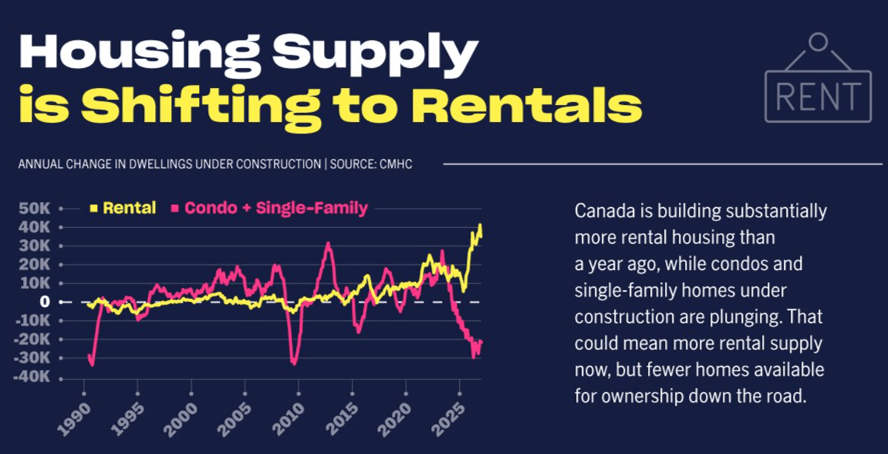
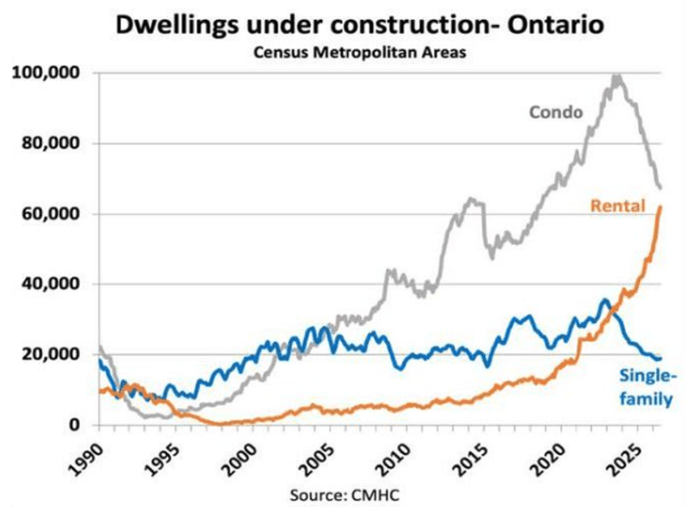
Canada Gradually Becoming A Renter Nation. Historically high real estate prices, relatively high interest rates, and years of above average inflation have made home ownership difficult to attain for many young Canadians. The overall home ownership rate in Canada has fallen to ~66%, down from a peak of ~69% in 2011, but it is the younger cohort that accounts for the majority of the decline in ownership. The decline in affordability combined with government incentives pivoting from exclusively helping young homeowners buy first homes to helping developers construct as many new homes as possible has resulted in an unprecedented increase in rental housing development and an annual decline in single-family home and condo development that is in line with the early 1990s housing downturn and 2008 global financial crisis.
Our Take:
At 66%, despite a historically unaffordable market and following a period of elevated inflation, Canada still has one of the highest home ownership rates in the world. It is natural to expect that the home ownership rate will decline from a world-leading level when Canadian house prices are well above average relative to household incomes. Governments pivoting away from helping first-time home buyers and toward developers is a reflection of what the current relatively unaffordable market can bear. First-time home buyer demand simply isn’t there, in aggregate at least, and incentivizing rental property development may be the only way to boost overall housing supply, helping improve overall long-term housing market affordability while keeping the greater Canadian economy chugging along. That said, while rental property development may help improve condo and potentially townhome affordability, it does nothing to help improve detached or semi-detached home affordability and these types of properties will become increasingly scarce as a percentage of the population.
JUST FOR FUN
- MapQuest, remember that?! MapQuest surged in popularity after it proclaimed that it would not rename Lake Ontario to Lake America after US President Trump signed an executive order changing the name. Similar to its response to the renaming of the Gulf of Mexico, the company launched a tool allowing people to create their own name for the lake. The app was downloaded hundreds of thousands of times, and for a time, dethroned ChatGPT as the top free app in the Apple App Store. Turns out you don’t need to be at the forefront of AI to be a top app these days!
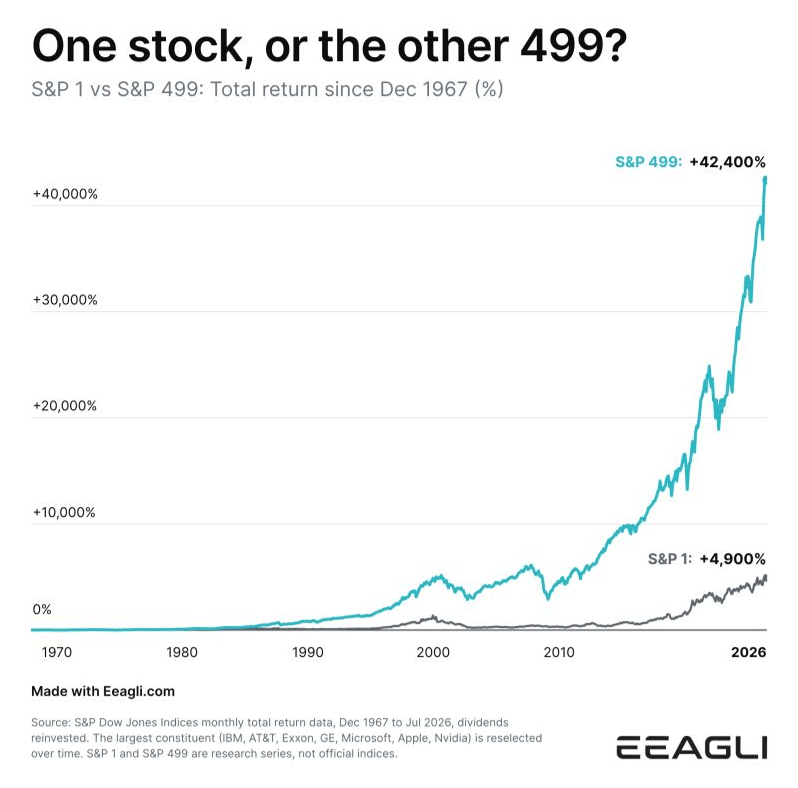
- Diversification can be a tough pill to swallow when it seems a single stock is driving the majority of equity market returns. Not owning the stock, or owning less of the stock than average, can mean an investor underperforms broad indices like the S&P 500. Whether it be IBM in the 80s, Microsoft in the 90s, Exxon in the 2000s, Apple in the 2010s, or Nvidia in the 2020s, the largest stock in the S&P 500 seems to be almost all anyone talks about, and for good reason, the stock would’ve had to perform incredibly well to become the largest stock, making many investors wealthier along the way. The problem is that this strong performance often stops when they become the largest stock.
Being the largest stock often reflects a significant and mature business that may be experiencing a growth slowdown, and the company may face difficulty finding new avenues for growth that are substantial enough to meaningfully drive overall company revenue growth. Being a large company also means you have a target on your back and every other company that is capable will try to compete for the business you currently dominate. Slowing growth often instigates a valuation decline so a stock losing its crown as #1 in the S&P 500 can be for a variety of interconnected reasons.
Below we can see just how hard it is for the S&P 500’s largest stock, at least from an investor point of view. Since December 1967 and until July 2026, the largest stock in the S&P 500 returned 4,900% while the other 499 stocks in the S&P 500 returned 42,400%. On an annualized basis, that equates to 6.9% annually versus 10.9% annually. Diversification works!
A 6.9% long-term return is nothing to turn one’s nose up at, but some caution may be warranted when considering the S&P 500’s largest stock relative to the other 499.